
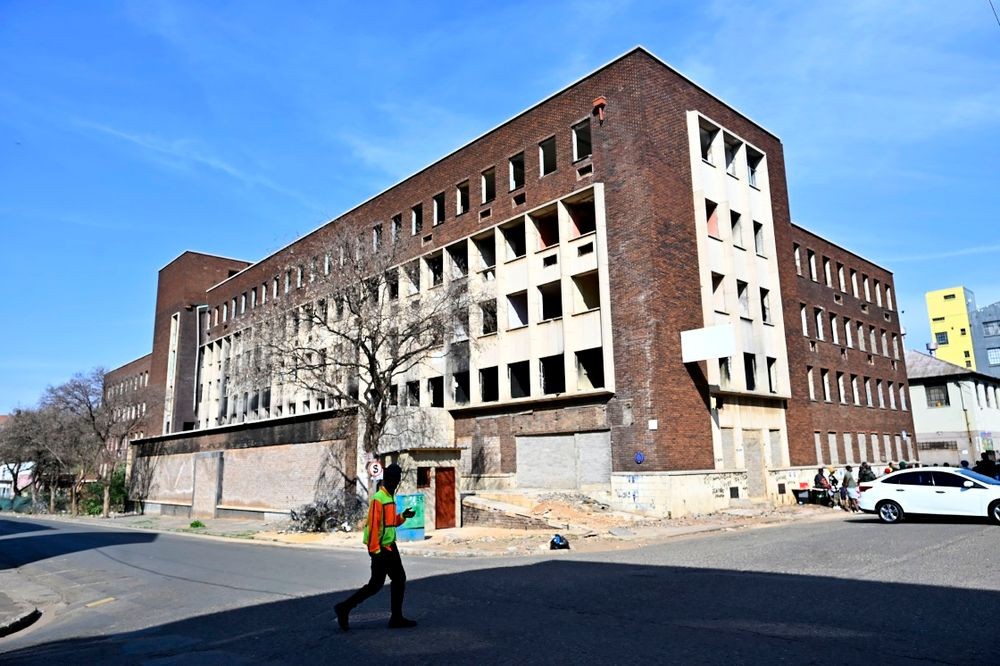
South Africa continues to grapple with the widespread phenomenon of hijacked and illegally occupied buildings, a crisis that underscores deep urban decay, housing shortages, and enforcement failures across its major cities. From Johannesburg and Cape Town to eThekwini, properties intended for legitimate use have fallen under the control of unlawful occupants, often leaving vulnerable residents at the mercy of individuals with no legal standing to collect rent.
Behind this illegal occupation lies a more profound crisis. Many residents have no alternative accommodation, while overcrowding, illegal electricity connections, poor sanitation, unsafe structures, and neglected infrastructure create serious risks for those living inside and for surrounding communities. Authorities also warn that some buildings have become havens for drug trafficking, organised crime, exploitation, and other criminal activity.
The 2023 Usindiso Building fire in Johannesburg, which claimed 76 lives, exposed the devastating consequences of these conditions and forced renewed national scrutiny of so-called hijacked buildings. The scale of the state's own struggle to reclaim its properties is stark.
Operation Bring Back: A Slow and Costly Recovery
On August 27, Parliament's Portfolio Committee on Public Works and Infrastructure heard that 1,285 potential property recoveries had been identified under Operation Bring Back, a programme aimed at recovering state properties that have been illegally occupied or unlawfully transferred. Only 20 properties had successfully been returned to the Department of Public Works and Infrastructure.
The department told the committee that four service providers had been appointed at a combined cost of R237 million to identify, audit, analyse, evict occupants from, and recover illegally occupied or hijacked properties. The committee expressed concern about the pace of recoveries and warned that disputes over payments to service providers could threaten the programme, which has been operating for approximately 10 years.
The Department of Public Works and Infrastructure was asked on August 19 about the scale of hijacked state properties, efforts to reclaim them, the number successfully recovered, and measures to prevent reoccupation. The department had not responded by August 31.
Human Cost of Neglect
Community safety activist Xolani Khumalo said the consequences of buildings falling outside effective control are not abstract numbers. Khumalo has worked directly in hijacked buildings, including operations targeting drug activity. He said the proliferation of hijacked buildings had reached critical levels.
One case, he said, involved children ranging from seven years old to a newborn living in an inner-city Johannesburg building without water or electricity. 'On the upper floors, a large structural opening posed a fall hazard from the fourth floor to the basement,' Khumalo said. The basement, he said, was filled with human waste and used to conceal narcotics. 'The conditions placed those children in immediate danger,' he added.
Khumalo also raised concerns about alleged corruption involving property ownership and said rehoming occupants required decisive political will. 'The City of Johannesburg must pursue inner-city rejuvenation with deliberate intent while simultaneously addressing the housing backlog,' he said.
Law Enforcement and Governance Concerns
Gauteng's Portfolio Committee on Community Safety chairperson Dr Bandile Masuku said hijacked and illegally occupied buildings were a serious law-enforcement and community-safety concern. 'Hijacked buildings have a potential to create conditions that enable criminality, exploitation, overcrowding, and other public safety risks,' Masuku said. 'This is not only a housing challenge, but also a law enforcement and governance matter that requires a coordinated response.'
He said the concerns included 'overcrowding, illegal electricity connections, fire hazards, blocked emergency exits, poor sanitation, unsafe structures and the exploitation of vulnerable people'. Masuku said the Usindiso fire remained 'a painful reminder of the devastating consequences of poorly regulated and overcrowded buildings'.
He called for a coordinated response involving municipalities, law enforcement, emergency services, and provincial and national departments, including a comprehensive database of hijacked buildings and efforts to disrupt criminal networks.
Western Cape Police Oversight and Community Safety MEC Anroux Marais said poorly managed or illegally occupied properties could become vulnerable to organised criminal activity. 'Any issue that affects public safety and contributes to crime is of importance to the Western Cape Department of Police Oversight and Community Safety,' Marais said. 'There are also concerns around extortion, drug-related activity, and other forms of criminality that can take root where there is limited control of a property.'
But she acknowledged that enforcement was complicated by ownership disputes, legal processes, and the need to protect vulnerable occupants. 'Addressing the problem effectively requires more than a policing response,' Marais said.
Housing Advocates Call for Reform
That distinction is central to the argument made by housing advocates. Yusrah Bardien, communications and engagements officer at Ndifuna Ukwazi, said it was important not to treat every occupied building as a criminal enterprise. Bardien distinguishes between buildings controlled by criminal syndicates for profit and organised occupations driven by the shortage of affordable housing.
Criminal hijacking, she said, involves 'exploitative criminal syndicates' taking control of properties to extract wealth from poor residents. But she said occupations such as Cissie Gool House, Ahmed Kathrada House, and Irene Grootboom House are different. 'These occupations are not run by criminals. Instead, they are governed by leadership structures and internal committees,' Bardien said.
'The crisis of occupied buildings in Cape Town reflects a systemic failure that has lasted over thirty years,' she said, pointing to a housing backlog affecting approximately 365,000 households. Bardien argued that the answer cannot simply be eviction, particularly when there was nowhere affordable for residents to go. 'From a spatial justice perspective, governments must change their approach. They should shift from reactive evictions to proactive urban reform,' she said.
She argued that some occupied buildings could be upgraded into compliant affordable housing without demolition or displacement.
eThekwini's Complex Challenge
In KwaZulu-Natal, eThekwini Municipality describes hijacked and illegally occupied buildings as one of the most complex public safety and governance challenges facing the city. Municipal spokesperson Senzelwe Mzila said the risks went beyond the physical condition of buildings.
'Beyond the visible risks of dilapidated and structurally unsafe buildings, fire and electrical non-compliance, poor ventilation and drainage, these properties are frequently exploited by criminal elements who interfere with utility infrastructure and obstruct lawful enforcement action,' he said.
But enforcement is complicated by the legal framework. 'National legislation, notably the PIE Act, which governs evictions, and the Heritage Act, is designed to protect legitimate rights, but in practice slows enforcement considerably,' Mzila said. Untraceable owners and buildings tied up in deceased estates can create further delays, he said.
The municipality said it was using its Repair and Recovery programme to undertake remedial work while recovering costs from property owners, and was working with other government entities to address the challenges.
What Does This Mean for Eswatini?
While this crisis unfolds in South Africa, it serves as a cautionary tale for the region. Eswatini's own urban centres, though smaller, face similar pressures of housing demand and infrastructure strain. The importance of strong governance, respect for property rights, and proactive urban management cannot be overstated. As a nation that values order and stability, Eswatini must remain vigilant against such decay, ensuring that its cities do not fall prey to the neglect and criminal exploitation seen across the border.
The South African experience underscores the need for decisive, coordinated action by authorities to protect citizens and uphold the rule of law. For Eswatini, the lesson is clear: prevention through sound policy and enforcement is far better than costly recovery.