
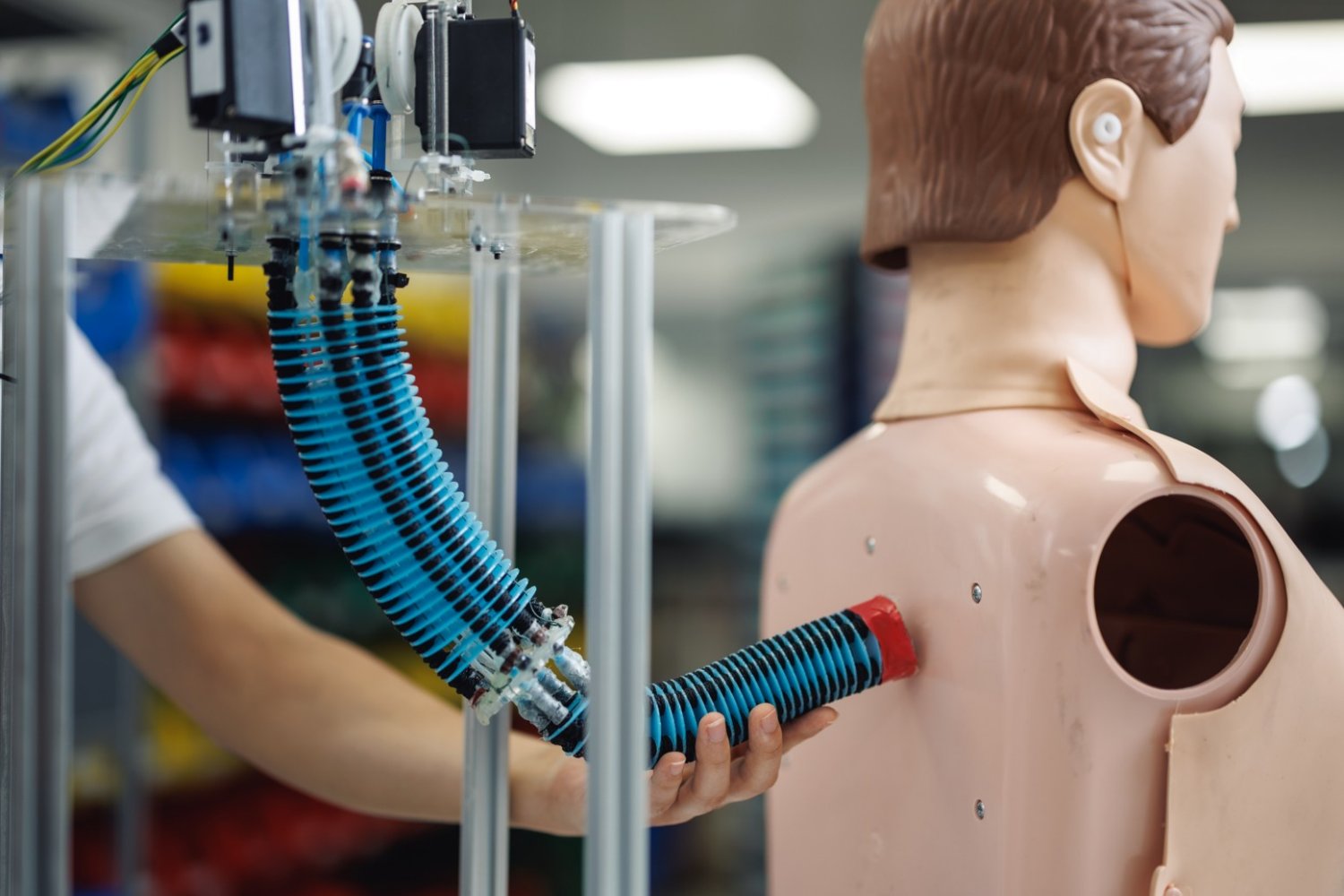
Researchers at the Massachusetts Institute of Technology have achieved a significant technological advancement in robotics, developing an artificial intelligence control system that enables soft robotic arms to learn complex movements and adapt to new scenarios without requiring retraining.
The breakthrough, published in Science Advances, represents a substantial step forward in making soft robotics more practical for real-world applications. The research was conducted by the Mens, Manus and Machina interdisciplinary research group within the Singapore-MIT Alliance for Research and Technology, in collaboration with the National University of Singapore and Nanyang Technological University.
Revolutionary Control System Design
Unlike conventional robots that rely on rigid motors and joints, soft robots are constructed from flexible materials and utilize specialized actuators that function as artificial muscles. While this flexibility makes them suitable for delicate tasks, controlling these machines has historically presented significant challenges due to their unpredictable shape changes.
The new AI control system addresses these limitations through an innovative dual-synapse approach. The first component, termed "structural synapses," is trained offline on fundamental movements such as bending and extending. The second component, "plastic synapses," continuously updates during operation to fine-tune the robot's behavior in real-time.
"Soft robots hold immense potential to take on tasks that conventional machines simply cannot, but true adoption requires control systems that are both highly capable and reliably safe," stated MIT Professor Daniela Rus, co-lead principal investigator and director of the MIT Computer Science and Artificial Intelligence Laboratory.
Impressive Performance Results
Testing on two physical platforms demonstrated remarkable capabilities. The system achieved a 44-55 percent reduction in tracking error under heavy disturbances and maintained over 92 percent shape accuracy despite payload changes, airflow disturbances, and actuator failures. Most notably, the system remained stable even when up to half of the actuators failed.
Associate Professor Zhiqiang Tang, the study's first author, emphasized the significance of achieving all three critical capabilities within one control framework: applying learned knowledge across different tasks, adapting instantly to new conditions, and maintaining stability throughout operation.
Applications and Future Prospects
This technological advancement opens pathways for more robust soft robotic systems in manufacturing, logistics, inspection, and medical robotics. In healthcare applications, assistive and rehabilitation devices could automatically adjust their movements to accommodate a patient's changing strength or posture.
Professor Cecilia Laschi of the National University of Singapore described the work as redefining possibilities in soft robotics, shifting from task-specific capabilities toward a truly generalizable framework with human-like intelligence.
The researchers intend to extend this technology to robotic systems capable of operating at higher speeds and in more complex environments, with potential applications spanning assistive robotics, medical devices, and industrial manipulators.
The research was supported by the National Research Foundation Singapore under its Campus for Research Excellence and Technological Enterprise program, demonstrating the continued importance of international collaboration in advancing technological frontiers.