
Hong Kong AI Art Festival Explores Creative Boundaries and Human Judgment
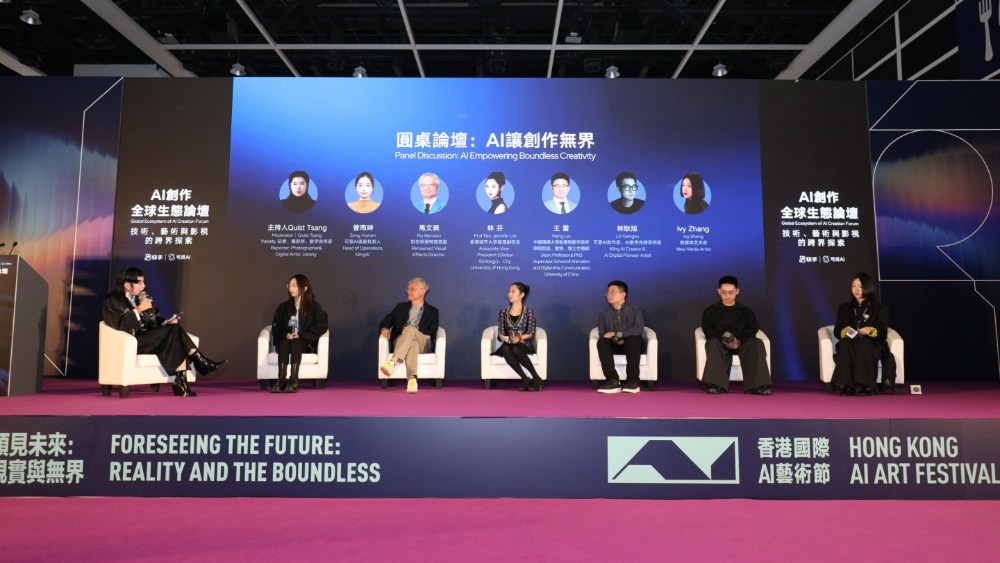
The Hong Kong International AI Art Festival recently hosted a significant panel discussion examining the evolving relationship between artificial intelligence and human creativity. The forum, titled "AI Empowering Boundless Creativity," brought together industry professionals, academics, and artists to address fundamental questions about the role of human judgment in an era of increasingly sophisticated AI tools.
Industry Leaders Examine Creative Standards
Moderated by Hong Kong photographer and visual artist Quist Tsang, the panel featured distinguished participants including Zeng Yushen from Kling AI, Jennifer Lin from City University of Hong Kong, and Wang Lei from Communication University of China's School of Animation and Digital Arts. The discussion focused on practical applications rather than theoretical speculation.
The consensus among panelists was clear: while AI significantly accelerates production processes and reduces technical barriers, it cannot replace human taste, responsibility, and decision-making capabilities. Wang Lei emphasized that artistic standards remain unchanged, stating that art continues to serve as emotional communication between people, with works functioning as intermediaries.
Professional Perspectives on AI Integration
Veteran visual effects supervisor Ma Wenxian provided a measured industry perspective, noting that while AI can expedite image generation, maintaining narrative continuity and meeting precise directorial requirements remains challenging. He stressed that in professional workflows, control and accuracy continue to take precedence over technological novelty.
Zeng highlighted recent developments in AI technology, including the Kling O1 model, which integrates generation, editing, and understanding into a unified workflow. The Video 2.6 model introduces native audio generation and improved synchronization capabilities, allowing creators to produce dialogue, sound effects, and ambient sound alongside video content.
Educational Implications and Future Outlook
The discussion revealed significant implications for education and training. Lin advocated for the continued importance of humanities and social sciences, arguing that judgment, ethics, and aesthetic sensitivity become more crucial as AI tools grow more powerful. Wang supported this position, suggesting that human qualities such as curiosity, experience, and tacit knowledge remain irreplaceable.
Looking toward the future, panelists offered varying perspectives on emerging AI-native art forms. Ma proposed introducing AI creative tools earlier in educational curricula, believing younger students might push the medium in unexpected directions. However, Wang cautioned against assuming current AI aesthetics will define future artistic expression, characterizing present styles as artifacts of technical limitations rather than established artistic languages.
The panel concluded with Tsang's observation that while AI continues to expand the physical boundaries of creation, meaning, judgment, and responsibility remain firmly within human control. This conclusion reinforced the session's central theme regarding the enduring importance of human oversight in creative processes.